
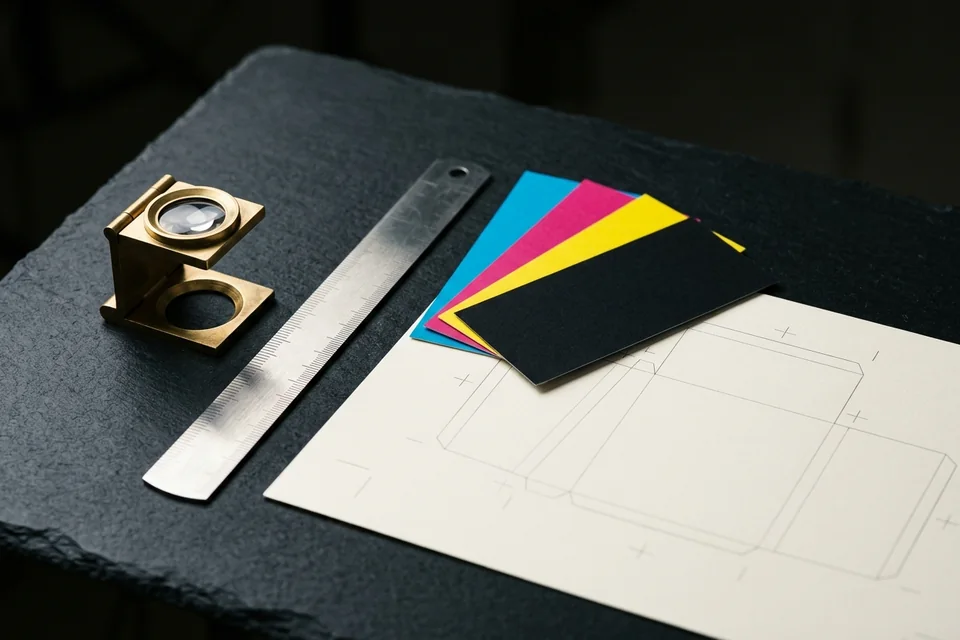
Three job conditions change how files are prepared:
- PDF/X-1a vs. PDF/X-4: Use PDF/X-1a when flattening transparency into pure CMYK and spot separations for legacy RIPs. Use PDF/X-4 when preserving live transparency and layered spot or white-ink overprints for modern RIPs.
- Multilingual black-plate swaps: When multiple language editions share identical artwork across offset runs (standard offset card runs start at 200 decks, with usual tiers at 200, 300, 500, and 1,000+), isolate all localized text, icons, and market marks onto a 100% K plate so only the black plate changes on press while the CMY plates remain fixed.
- Component geometry and substrate: Cards, rigid-box wraps, punchboards, leaflets, and bound booklets require different bleed, wrap-margin, die-gap, and page-count structures before sheet imposition, and dark or metallic substrates require a dedicated spot-white underbase layer.
Core Prepress Specifications
Trim dimensions are defined by each job's approved card, box, or punchboard die-line rather than a single default trim; all bleed and safety offsets are measured outward and inward from that job-specific trim line.
| Parameter | Specification | Production Condition / Notes |
|---|---|---|
| Source & Print Formats | AI, PDF, PSD; export PDF/X-1a or PDF/X-4 | Fonts must be outlined or fully embedded |
| Resolution | ≥300 DPI at 100% print size | Vector artwork required for fine text, borders, and spot masks |
| Color Mode | CMYK + named spot layers | Convert RGB assets to CMYK before export |
| Fine Text Black | 100% K (C0 M0 Y0 K100) |
Prevents registration halos and enables black-plate swaps |
| Rich Black | C40–60 M30–40 Y30–40 K100 | Use for large solid black areas; never for body text |
| Total Area Coverage (TAC) | ≤280%–300% | Higher ink loads delay drying and increase scuffing |
| Bleed | 3 mm (0.118 in) per side | Required on all trimmed edges |
| Safety Margin | ≥3 mm (0.118 in) standard; ≥4–5 mm (0.157–0.197 in) for bordered backs | Keeps text and inner frames clear of die-cut variance |
| Card Corner Radius | R3–R3.5 mm (0.118–0.138 in) | Align corner artwork and borders to the die radius |
| Box Wrap Margin | 15–20 mm (0.591–0.787 in) | Wrap allowance over 1.5, 2, 2.5, or 3 mm (0.059, 0.079, 0.098, or 0.118 in) greyboard |
| Punchboard Die Gap | 3–4 mm (0.118–0.157 in) | Minimum spacing between adjacent die-cut tokens |
| Box Clearance | 1.5–2.5 mm (0.059–0.098 in) width/height; 1.5–3 mm (0.059–0.118 in) stack height | Built into box die-lines around decks and components |
| Leaflets & Booklets | Leaflets: 4, 6, or 8 panels; Bound signatures: multiples of 4 | Saddle stitch: 12–40 pp; Perfect: 28+ pp; Sewn: 80–100+ pp recommended |
| Booklet Paper Weight | Interior: 80–120 gsm (~0.08–0.13 mm / 0.003–0.005 in per sheet); Cover: 200–300 gsm | Affects spine width and creep compensation during imposition |
Surface finish and ink interactions: Dark, high-coverage artwork pairs with anti-scuff matte finishes to resist marking during handling and collation. When a deck specifies gilded edges, avoid thick lamination films that can conflict with edge gilding adhesion and clean edge trimming.
Separations, White Ink, and Specialty Masks
Every non-process element must sit on its own named vector spot channel rather than being simulated in CMYK:
- Die-lines, Creases, and Perforations: Place all cut, fold, and perf vectors on a dedicated top layer named for the operation (such as
Dieline), assigned a distinct 100% spot swatch set to overprint and flagged as non-printing. If a die-line is set to knockout, it leaves a white gap around every cut edge when plates are separated. - White Ink Underbase: For metallic stocks, dark substrates, or clear plastics, create a dedicated
Whitespot channel beneath the CMYK artwork. Set the CMYK objects above it to overprint where color prints onto the white base, and choke the white mask slightly inward where fine edges meet unprinted substrate so white halos do not peek out under registration variance. - Specialty Finish Masks (Foil, Spot UV, Emboss/Deboss): Supply 100% solid vector fills on separate named spot layers (
Foil,Spot_UV,Emboss) aligned to the exact trim coordinates. Do not use gradients, rasterized halftones, or transparency inside foil or embossing masks.
Imposition and Multilingual Black-Plate Swaps
Offset printing groups cards, punchboards, box wraps, and booklet pages onto large press sheets based on run tier, stock caliper, and finishing sequence.
- Deck and Component Imposition: Cards are imposed in sheet grids matched to the deck's card count and die tooling, with 3 mm (0.118 in) bleed per card and clean gutter spacing for guillotine slitting or punch-die cutting. Punchboards require 3–4 mm (0.118–0.157 in) between token cuts so the board maintains structural integrity during die-cutting.
- Booklet Imposition and Creep: Bound booklets impose pages into 4-page signatures (12–40 pages for saddle stitch, 28+ pages for perfect binding, and 80–100+ pages recommended for sewn binding). For saddle-stitched booklets on 80–120 gsm interior stock (~0.08–0.13 mm / 0.003–0.005 in per sheet), outer signatures wrap further around inner signatures; spine width and inner-margin creep are calculated from page count and sheet caliper during imposition.
- Multilingual Black-Plate Swaps: To run multiple language versions without re-imaging all four CMYK plates per language, separate the file structure as follows:
Plates_Shared = Cyan + Magenta + Yellow + Spot_FinishesPlate_Language_N = Black (100% K only)- Keep all localized text, rules, iconography, and regulatory markings strictly in
C0 M0 Y0 K100with overprint enabled over light backgrounds, or place them inside clean white knockout boxes shared across all languages. Any CMY tint, rich black, or drop shadow inside localized text forces a full four-plate change per language.
Conditional Regulatory Markings in Artwork
When a product's target market or classification requires statutory markings on the box, insert, or card back, reserve clear safety-zone space on the 100% K layer and retain the corresponding compliance records:
- Toy safety assessment (EU): Where a tabletop product falls within toy safety scope, EN 71 assessment and testing records govern the required conformity markings and warnings per the EU Toy Safety framework.
- Packaging participation and sorting marks: For distribution into Germany or France, reserve space for applicable packaging registration or sorting marks (such as Triman) according to Zentrale Stelle Verpackungsregister (VerpackG) and French Ministry Info-Tri (Triman).
Production Steps and Sign-Off Criteria
Follow this sequence before press plates are imaged:
- Template Setup: Build artwork on the job-specific die-line with 3 mm (0.118 in) bleed per side, ≥3 mm (0.118 in) safety (≥4–5 mm / 0.157–0.197 in for bordered backs), and 15–20 mm (0.591–0.787 in) wrap margins for rigid-box wraps.
- Color & Separation Audit: Convert all imagery to CMYK at ≥300 DPI, cap TAC at ≤280%–300%, enforce 100% K on fine text and swappable language layers, and verify C40–60 M30–40 Y30–40 K100 on large rich-black solids.
- Spot & Overprint Verification: Confirm white ink, foil, spot UV, and die-lines sit on separate named spot layers with correct overprint/knockout attributes.
- PDF/X Export & Preflight: Export to PDF/X-1a or PDF/X-4 with all fonts outlined or embedded. Inspect plate separations in a RIP or Acrobat separation preview.
- Imposition & Proof Sign-Off: Review the imposed sheet layout, booklet pagination (multiples of 4), and language black-plate overlays.
File Acceptance Sign-Off Criteria:
- Zero RGB or unapproved spot channels remaining in process layers.
- All raster links ≥300 DPI at final scale; zero missing fonts.
- Bleed extends cleanly 3 mm (0.118 in) beyond every trim edge; bordered backs respect ≥4–5 mm (0.157–0.197 in) safety.
- TAC does not exceed 300% anywhere on the sheet.
- Die-line layer is isolated, non-printing, and set to overprint.
- For multilingual jobs, switching the K plate leaves CMY plates identical.
Concrete Failure Modes
- Off-Center Bordered Backs: Placing card-back frames closer than 4–5 mm (0.157–0.197 in) to the trim edge makes minor die-cut shifts visually obvious across a stacked deck.
- Broken Black-Plate Swaps: Using rich black (
C40–60 M30–40 Y30–40 K100) or CMY drop shadows on localized text forces all four process plates to be re-imaged for every language edition and causes color-fringe halos on small type. - Ink Set-Off and Scuffing: Exceeding 280%–300% TAC on coated art stock slows ink drying, transfers wet ink onto adjacent sheets in the delivery pile, and increases scuffing on dark areas if not paired with an anti-scuff matte finish.
- White Gaps Along Cut Lines: Leaving the
Dielinespot stroke set to knockout instead of overprint punches a thin white outline into the bleed edge around every card or token. - Short Box Wraps: Extending rigid-box cover artwork only 3 mm past the board edge instead of the 15–20 mm (0.591–0.787 in) wrap margin exposes raw 1.5–3 mm (0.059–0.118 in) greyboard on the interior turn-in.
- Gilded Edge Delamination: Specifying thick lamination films on decks with gilded edges interferes with edge-trimming uniformity and foil adhesion along the card stack.